
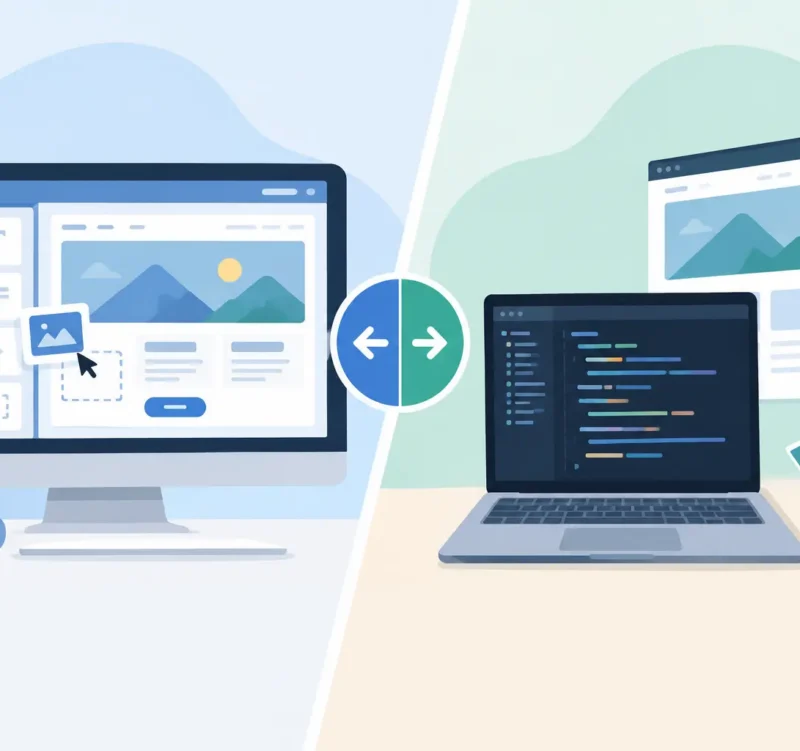
A website that looks fine but fails to bring in calls, appointments, quote requests, or visits is not doing enough for your business. The real question in a website builder versus custom design decision is not which option sounds more impressive. It is which option gives your customers the confidence to choose you and gives your team a practical way to keep the site working.
For a local contractor, restaurant, nonprofit, law office, retailer, or professional practice, your website is often the first proof that your business is established, capable, and easy to work with. A low upfront price can be appealing. So can a fully custom site. Both can be the right answer, but they solve different problems.
What a Website Builder Does Well
A website builder is a platform that lets you create a site using prebuilt templates, editing tools, and packaged features. Many small businesses choose this route because it can get a basic website online quickly and at a lower initial cost.
For a new business with a limited number of services, a straightforward website builder can be a reasonable starting point. If you need a few pages, a contact form, business hours, service descriptions, and a gallery of recent work, a well-organized template may cover the essentials. It can also make routine edits easier when someone on your team needs to change a staff bio, post a special, or update holiday hours.
The strongest website-builder projects are focused. They use a clean template, clear navigation, real photography where possible, and concise copy that explains what the business does and where it serves customers. The platform itself is rarely the issue. The issue is treating a template as a finished marketing strategy.
A builder can also work well when speed matters more than customization. Perhaps you are launching a seasonal business, validating a new service, or replacing an outdated one-page site while a larger brand effort is still in progress. In those cases, getting a clear, mobile-friendly presence in place may be the practical move.
Where Website Builders Can Hold You Back
The trade-off is control. Templates are designed to serve many types of businesses, which means they may not fit yours particularly well. You may be able to change colors, images, and text, but have limited freedom to adjust page layouts, lead forms, navigation, booking workflows, or the way service areas are presented.
That matters when your business has specific goals. A home services company may need separate pages for high-value services and Delaware service areas. A medical or professional practice may need a more structured path for new patients or consultations. A nonprofit may need donations, volunteer signups, events, and stories to work together without confusing visitors.
Website builders can also create a false sense of simplicity. Someone still needs to make smart decisions about page structure, calls to action, photography, search terms, accessibility, mobile behavior, and the message on every page. Dragging a text block onto a page is easy. Writing a convincing case for why a customer should call your business is harder.
There is also the long-term question of ownership and flexibility. Some platforms make it difficult to move your content, integrate specialized tools, or make advanced changes later. Monthly platform fees, add-on costs, and premium apps can add up as your needs grow. A bargain website can become expensive if it needs repeated workarounds to do what your business actually needs.
When Custom Website Design Is Worth It
Custom design does not have to mean a flashy, oversized website built for a national corporation. For small businesses, it means building the site around your brand, your customers, and the actions you need visitors to take.
A custom-designed website starts with questions a template cannot answer on its own. What makes your company different from the next local search result? What concerns do customers have before they call? Which services make the best use of your team’s time? What information builds trust quickly? Where are visitors dropping off now?
The answers shape the site. A custom approach can create a clearer service structure, stronger local search pages, more useful contact paths, and a visual identity that matches the quality of your work. Instead of trying to force your message into a generic layout, the layout supports the message.
This is especially valuable for businesses that have outgrown a simple brochure site. If you have multiple locations, a broad service area, detailed offerings, online forms, recurring marketing campaigns, or a brand that needs to look consistent across print and digital materials, custom design can reduce friction and present a more professional face to the market.
Custom work also gives you room to plan ahead. The site can be built with future pages, campaigns, integrations, and maintenance needs in mind. That does not mean paying for every possible feature on day one. It means avoiding a structure that has to be rebuilt every time the business adds a service or changes direction.
The Real Cost Is More Than the Launch Price
A website builder generally costs less to launch, particularly if you create it yourself. Custom design costs more upfront because it includes planning, design, development, content direction, testing, and project management. For a business watching every dollar, that difference is real.
But launch price is only one part of the investment. Consider the time you will spend building and maintaining the site, the leads lost when visitors cannot quickly understand your offer, and the cost of redesigning a rushed site a year later. Consider whether the website helps your sales process or creates more questions for your staff to answer.
A website should earn its place in your budget. If one additional project, account, patient, or client can cover a meaningful part of the investment, then clarity and conversion matter more than getting the cheapest possible monthly plan. On the other hand, if your immediate need is simply to establish a credible presence while you build momentum, a builder may be the responsible choice.
Website Builder Versus Custom Design for SEO
Neither option automatically puts a business at the top of search results. Search visibility comes from useful content, clear site structure, local relevance, technical health, and ongoing effort. A website builder can support solid SEO basics when it is set up correctly. A custom site can provide greater control over structure and performance, but it still needs thoughtful content and regular attention.
For local businesses, the bigger opportunity is often relevance. Your website should clearly explain your services, the communities you serve, and why customers can trust you. It should make it easy for search engines and people to understand the difference between your Wilmington office, your Sussex County presence, or the areas your crews serve.
Custom design can be a stronger fit when SEO is a major source of leads because it allows the site to be organized around your priorities from the beginning. But a custom site with thin copy, no updates, and no maintenance will not outperform a well-managed builder site simply because it is custom.
Choose Based on Your Next Two Years
Do not choose a platform only for what your business needs this week. Think about the next two years. Will you add services, staff, locations, online scheduling, lead magnets, case studies, or a regular content program? Will multiple people need access to the site? Do you need someone dependable to handle updates when you are busy running the business?
A website builder is often a good fit when your needs are simple, your budget is tight, and you are comfortable working within a template. Custom design is usually the better fit when your website needs to actively support growth, distinguish you from competitors, and connect with a larger marketing effort.
There is a middle ground, too. A professional team can use the right platform while still providing strategic structure, original design direction, quality content, and ongoing support. The goal is not to make the project more complicated than it needs to be. The goal is to make sure your website looks your best and works hard for your business.
Catalyst Visuals helps Delaware organizations make that choice with the full picture in view: your budget, your brand, your customers, and the work you need your website to do. Start with the customer action that matters most, then build a site that makes taking that next step feel easy.