
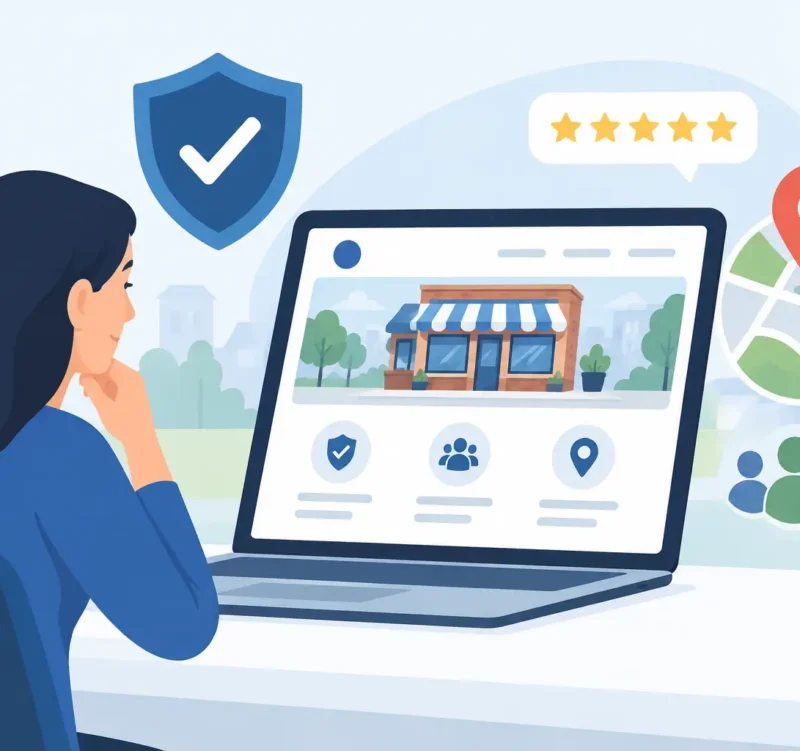
A potential customer finds your business after a quick search, lands on your homepage, and makes a decision in seconds: stay, call, or leave. What makes a website credible is not one flashy feature. It is the steady impression that your business is legitimate, capable, easy to reach, and ready to help.
For a local business, that impression has real consequences. A homeowner looking for a contractor, a parent choosing a pediatric practice, or a nonprofit supporter considering a donation is often comparing several options at once. If your website feels outdated, confusing, or incomplete, they may move on before they ever learn how good your work is.
What Makes a Website Credible?
A credible website makes it easy for visitors to answer the questions that matter most: Who are you? What do you do? Can you handle my need? Are you nearby? How do I contact you?
The strongest small-business websites do not try to impress people with complicated effects or industry jargon. They look professional, communicate clearly, and offer evidence that the business behind the screen is real. Credibility comes from the way all those details work together.
Professional design signals that you care
Your website is often the first version of your business that a customer sees. A dated layout, fuzzy logo, mismatched colors, crowded pages, or hard-to-read text can make even an experienced company appear less established than it is. That is unfair, but it is how quick online decisions work.
Professional design does not mean your site needs to look expensive or overly elaborate. It means the visual presentation fits your business and gives visitors a clear path forward. Consistent colors, readable type, quality photography, and well-organized pages show attention to detail. For many customers, that care suggests you will bring the same care to their project, appointment, order, or service call.
A clean design also needs room to breathe. When every inch of a page is crowded with messages, badges, animations, and oversized headlines, people have to work too hard to find what they need. Clear hierarchy helps visitors understand what is most important and where to click next.
Clear messaging beats clever wording
A website should not make visitors guess what your business offers. Your homepage needs to quickly identify your services, the people or organizations you serve, and the area you serve. A Wilmington accounting firm, a Millsboro restaurant, and a Delaware home services company will each need a different message, but all should be direct.
Lead with the practical value you provide. Instead of broad claims about being a leader or delivering exceptional solutions, say what you do and why it helps. A visitor should be able to tell whether you are a fit without reading three paragraphs of marketing language.
Specificity builds confidence. Mention your service area when it matters. Explain your process in plain English. Describe the kinds of jobs, clients, or products you specialize in. The more clearly a customer understands your business, the less risk they feel in taking the next step.
Proof Turns Claims Into Trust
Every business says it provides great service. Credible websites show visitors why they should believe it.
Testimonials are one of the most useful forms of proof, especially when they are specific. A short statement that says a business was “great to work with” is positive, but a testimonial explaining that a contractor showed up on time, solved a difficult problem, and kept the project on budget is far more convincing. Use real customer feedback, with permission, and identify the person or organization whenever appropriate.
Portfolio examples, project photos, case studies, certifications, awards, and years in business can also help. A landscaping company can show completed properties. A law practice can explain relevant areas of focus without making promises about outcomes. A nonprofit can share the impact of a program. A restaurant can feature genuine food and atmosphere rather than generic stock images.
The right proof depends on your business. A newer company may not have decades of history, but it can still show its team, credentials, workmanship, and commitment to responsive service. An established company should not rely only on “serving the community since” language if its website offers little evidence of what it does now.
Real people make local businesses more believable
Customers want to know there are real people behind a local business. An About page is not filler. It is an opportunity to explain your experience, introduce leadership or staff, and share what matters to your company.
This does not require a long personal biography. A few good team photos and a straightforward explanation of your background can make a business feel much more approachable. For service businesses, showing the people customers may meet at their home or office can reduce uncertainty before the first call.
Accuracy matters here. Do not use staff photos that no longer reflect your team, outdated office locations, or claims that cannot be supported. Trust is hard to earn and easy to weaken when a customer finds conflicting information.
Make It Easy to Verify and Contact You
A credible website makes basic business details easy to find. Your phone number, email address, hours, service area, and physical address, if you have one, should be accurate and visible. Customers should not have to search through several pages just to learn whether you serve their town.
Your contact process should also match how people prefer to communicate. Some visitors want to call immediately. Others want to submit a simple form after business hours. A well-built site gives them a clear choice without demanding unnecessary information upfront.
If you use a contact form, keep it practical. Ask for the details you need to respond well, but do not turn a first inquiry into a lengthy application. Explain what happens next, such as when customers can expect a reply. Then follow through. A website cannot create credibility on its own if inquiries disappear into an inbox for days.
Consistent information across your website, social profiles, printed materials, and online listings matters too. A different phone number, old address, or conflicting business hours raises questions quickly. Small details tell customers whether your operation is organized.
Performance and Security Are Part of the Experience
A polished website that takes too long to load can still lose trust. People may not describe a slow site as untrustworthy, but they often associate delays, broken pages, and error messages with a business that is not keeping up.
Mobile usability is especially important for local searches. Many people are looking for a nearby service from their phone, often when they need help quickly. Your site should be easy to read, navigate, and contact from a smaller screen. Buttons need to be easy to tap, forms need to work, and key information should not be buried behind complicated menus.
Security also matters. Visitors should see a secure connection when they share contact details or submit information. If your website accepts payments, appointment requests, or sensitive information, proper security and regular updates are essential. This is not only a technical issue. It is part of protecting the confidence a customer places in your business.
Ongoing maintenance is where many websites fall behind. Team members change, services expand, promotions expire, and software needs updates. A credible website reflects the business you run today, not the one you ran five years ago.
Avoid the Credibility Gaps Customers Notice
Some website problems are obvious: broken links, spelling mistakes, pages that do not work on mobile, and expired announcements. Others are quieter but just as costly. Generic stock photos can make a business feel interchangeable. Thin service pages can leave customers unsure whether you have the experience they need. Pop-ups that block the page before visitors can read it can feel pushy rather than helpful.
There are trade-offs. You do not need to publish every detail of your pricing, process, or internal operations online. Some businesses need a conversation before giving an accurate estimate, and that is reasonable. But visitors should understand enough to feel comfortable starting that conversation.
Likewise, a small business does not need a massive website to look established. A focused site with a strong homepage, clear service pages, genuine proof, and reliable contact information often performs better than a large site filled with outdated or repetitive content.
Build Trust Before You Ask for the Call
Your website should earn confidence before it asks someone to fill out a form or pick up the phone. Start by viewing it as a first-time customer would. Can you immediately tell what the business does? Does it look current? Is there proof that real customers trust it? Can someone contact you without friction?
If the answer is no, fixing those gaps can make a meaningful difference in how your business is perceived. A credible website does not need to shout. It simply helps customers feel confident that they have found the right local business to call.