
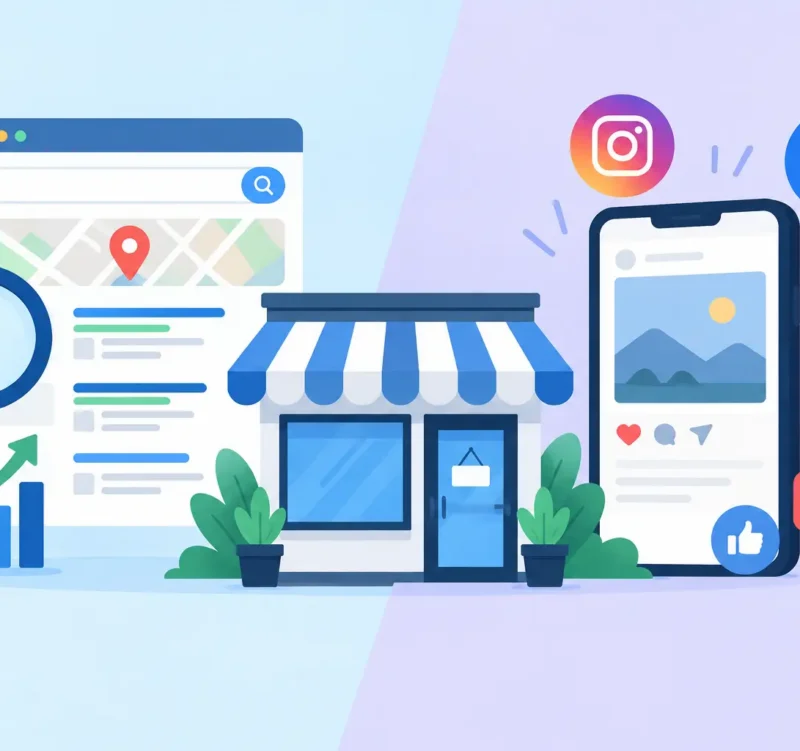
A homeowner with a leaking roof does not scroll social media looking for a contractor to admire. They search for help. A diner deciding where to eat on a Friday night may do the opposite: check Facebook or Instagram to see what looks good, what is happening, and whether the place feels worth the trip. That is the practical difference in the SEO versus social media conversation for Delaware small businesses.
Both can help you get noticed. Both can build trust. But they do not work the same way, and treating them as interchangeable can drain a limited marketing budget without producing the calls, visits, or sales you need.
SEO Versus Social Media: Different Jobs, Better Results
Search engine optimization, or SEO, helps your business appear when people are actively looking for what you offer. Social media helps you stay visible, show personality, and remain part of the conversation before a customer is ready to buy. One captures demand. The other can create familiarity and encourage demand over time.
For a Wilmington attorney, plumber, dentist, accountant, or home services company, search is often where high-intent leads begin. Someone searching for “emergency plumber near me” or “estate planning attorney in Wilmington DE” has a problem and is looking for a provider. A clear, professional website supported by local SEO can put your business in front of that person at the moment it matters.
Social media plays a different role. It gives a Sussex County restaurant a place to post a lunch special, lets a nonprofit promote an upcoming fundraiser, and helps a retail shop show new inventory or introduce the people behind the counter. These posts give customers reasons to remember you, visit you, and recommend you. They also help prove that your business is active, responsive, and real.
The mistake is asking one channel to do the other’s job. A steady Instagram presence will not automatically make you rank for competitive local searches. A well-optimized website will not replace the relationship-building value of event photos, customer stories, and timely community updates.
When SEO Should Lead the Marketing Plan
SEO deserves priority when customers usually search before they choose. This is especially true for businesses selling services people need, not just services they happen to discover. Contractors, medical and professional practices, repair companies, financial firms, legal offices, and B2B providers often benefit most from strong search visibility.
A useful SEO program is more than adding a few keywords to a homepage. It starts with a website that clearly explains what you do, where you work, and why customers should trust you. Each important service needs an easy-to-find page written in plain language. Your contact information needs to be consistent. Your site needs to work well on a phone. Local signals, useful content, accurate business profiles, and ongoing technical maintenance all support the bigger goal: helping the right customer find you and take the next step.
SEO is not the fastest marketing channel. A new or outdated website may need months of steady work before rankings and traffic build momentum. Competition matters, too. A Delaware roofer competing in a crowded market will face a different path than a specialized provider serving a narrow niche.
Still, the long-term value can be significant. Unlike a social post that may get most of its attention within a day or two, a strong service page can keep bringing in qualified visitors long after it is published. That makes SEO a practical investment for businesses that want dependable visibility, not just occasional bursts of attention.
SEO is a strong fit when customers ask practical questions
If your best prospects are searching for answers such as “who repairs this,” “where can I get this,” or “which company serves my area,” start by making sure your website can answer them better than your competitors. Be specific about your services, service areas, experience, and process. Show reviews, examples of your work, and straightforward ways to contact your team.
Your website is often the place where a customer decides whether you look established enough to call. Good SEO brings them there. Professional design, clear messaging, and a user-friendly experience give them a reason to stay.
When Social Media Should Take Center Stage
Social media can carry more weight when visual proof, frequent updates, and community connection influence the sale. Restaurants, salons, boutiques, event venues, fitness studios, artists, food businesses, and local organizations often have plenty to share. New products, seasonal promotions, before-and-after projects, staff spotlights, and customer moments can all make a business feel current and approachable.
For local companies, social media is also a practical trust-builder. People want to see that you are involved in the community, that your team shows up, and that your work looks as good in real life as it does in an ad. A contractor can show a finished renovation. A nonprofit can show the impact of a donation drive. A professional office can introduce the people who will greet clients at the door.
But consistency matters more than chasing every trend. A neglected page with posts from two years ago can create doubt. So can a feed that is all sales messages and no useful, human content. Choose the channels your customers actually use and commit to a realistic schedule. For many small businesses, that means doing fewer things well instead of opening accounts everywhere.
Social platforms also control the rules. Algorithms change. Organic reach rises and falls. A post can perform well one week and disappear the next. Paid social advertising can extend your reach, but it works best when the offer, audience, visuals, and landing page are all working together.
Social media works best when it has something to support
A social post should rarely be the entire marketing plan. If someone sees a project photo, promotion, or event announcement, where do they go next? Your website should give them the details, proof, and contact options they need. If your profile sends visitors to a slow, confusing, or outdated site, the opportunity can end there.
This is why cohesive branding matters. Your social graphics, website, print materials, and in-person presentation should all look like the same business. Consistency makes a smaller company feel more established. It also makes your message easier to recognize when customers see you more than once.
How to Choose With a Limited Budget
Small-business marketing decisions become clearer when you start with customer behavior instead of platform hype. Ask how people typically find your business when they are ready to spend money. Do they search Google for a solution? Do they ask for recommendations in local groups? Do they follow businesses for inspiration and weekly specials? Do they need to see examples before they trust the work?
If urgent searches drive revenue, put the first dollars into your website, local SEO foundation, and business information. If frequent visual updates help fill seats, sell inventory, or promote events, make room for social content and targeted campaigns. If both are true, do not split your effort evenly by default. Give each channel a clear job.
For example, a local landscaping company might use SEO pages to attract searches for lawn care, hardscaping, and seasonal cleanups. Its social media can then show completed projects, offer maintenance reminders, and keep past customers engaged. The search strategy brings in people with a need. The social strategy makes the business memorable and reinforces confidence.
Measure results beyond likes and follower counts. Track phone calls, form submissions, direction requests, website visits, booked appointments, and actual sales. A post with modest engagement may still be valuable if it brings a high-quality customer through the door. On the other hand, a large audience means little if no one contacts you.
The Best Answer Is Usually Both, in the Right Order
SEO and social media work better together when the foundation is in place. Your website should be the home base you control. Search helps people discover it when they need you. Social media gives people more reasons to recognize, trust, and return to your business between searches.
For many local organizations, the sensible order is simple: look professional first, make it easy to be found, then stay visible with a manageable social presence. That may mean refreshing an outdated website before paying for more social ads, or creating a consistent brand before posting every day.
Catalyst Visuals helps businesses bring those pieces together so their marketing does not feel scattered across different vendors and disconnected messages. The goal is not to be everywhere. It is to show up where your customers are looking, look your best when they find you, and give them a clear reason to choose you.
Start with the next customer you want to earn. Think about what they need to see, what they are likely to search, and what would make them feel confident picking up the phone. Build your marketing around that moment, and each channel will have a job worth doing.